 |
Victorian women hymn writers in Nottingham
When I set out, several years ago, to research the lives of Victorian women hymn writers, I had no idea what an enormous project I was undertaking. So far, I have unearthed about 500 and more are appearing all the time. It appears hymn writing was a socially acceptable means of creativity for girls and women, affording the opportunity to express emotion, spirituality, even passion, without impropriety. For some of the most prolific writers, like Charlotte Elliott and Frances Ridley Havergal, it also provided financial independence. Many of these writers concentrated their efforts, at least part of the time, on hymns and songs for children, as may be seen in the examples below, all of whom have local connections.
Ann Gilbert 1782-1866
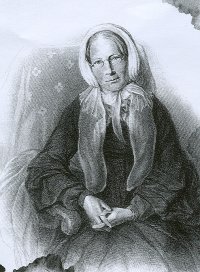 Born Ann Taylor into a well-known family of authors and engravers in Islington, the young Ann and her sister Jane were famous for their collection of poems and hymns for young children, Original Poems for Infant Minds, published in 1805 and reprinted many times. These poems were largely of the "improving" variety, such as Ann's "The Pin", in which careless Emily throws away a pin and then has to forego a grand party because she has nothing to pin together her finery! The collection also included Jane's famous, "Twinkle Twinkle Little Star".
In 1813 Ann married the Revd. Joseph Gilbert, a Congregational minister who, having read her poems, travelled from Essex to Devon on the outside of a coach, in winter, in order to propose! She was impressed and accepted him. In 1825 they moved to Nottingham where he became minister of Friar Lane Independent Chapel. They rented rooms in a wing of the Castle for a while, moving to a house in Castle Gate in 1830 from where, a year later, they witnessed the burning of the Castle during the Reform Riots.
Ann continued to write poetry: The Last Dying Speech of the Crocuses was written after a family outing to the Meadows in 1852, just before the area began to be built up with housing.
Her many hymns for children are mostly unsung today, but older readers may remember:
Great God! and wilt thou condescendJoseph died in 1852 but Ann lived in Nottingham for the rest of her long life and is buried in the General Cemetery.
To be my Father and my friend,
I a poor child, and Thou so high,
The Lord of earth and air and sky?
Mary Howitt 1799-1888
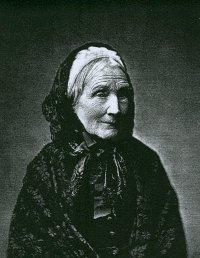 Mary was a native of Uttoxeter, born into the Botham family, who were strict Quakers. In 1821 she married William Howitt of Heanor, also a Quaker. They had much else in common, and though city folk (William ran a chemist's shop in Lower Parliament St, and later in South Parade), they loved the countryside and spent their honeymoon on a 500 mile walking tour, during which they stayed with the Wordsworths in the Lake District. They also had a "holiday cottage" in Wilford! Between them, they wrote 35 books of natural history, travel, fiction and poetry, lived in Europe at various times, and were acquainted with many literary giants of their day, including Tennyson, Mrs Gaskell and Elizabeth Barrett Browning. They also knew the Gilberts (see above).
Mary wrote many books for children and is best remembered for her sinister poem, "The Spider and the Fly" (Will you come into my parlour...?). In one of her hymns, God might have made the earth bring forth, she considers how God could easily have provided all we need without bothering with flowers and beauty, but He created them -
To comfort man, to whisper hopeWilliam and Mary Howitt are both buried in the Protestant cemetery in Rome, but are also commemorated by a double portrait sculpture in the courtyard of Nottingham Castle.
Whene'er his faith is dim;
For He who careth for the flowers,
Will care much more for him.
May Butler 1841-1916
May, or Mary, Butler was the youngest daughter of Thomas Butler, Rector of Langar. Another writer for children, she was overshadowed by the reputation of her more famous brother, the painter and author, Samuel Butler. She spent most of her life in Langar looking after her father and busying herself around the parish. She would regularly visit the village school to teach scripture and entries in the school log-book record her visits.
In 1876, the widowed Rector retired to Shrewsbury, taking May with him. Here she became involved in social work, especially the St Saviour's Home for Girls, many of her hymns being written for the inmates. By all accounts, her father was a hard, unloving parent, but in spite of this The Handbook to the Church Hymnary describes May as, "spiritual, intellectual, devoted; strong in her faithful following of duty; sweet-tempered, serene and cheerful from an active and disciplined life."
A popular Sunday School hymn by May which I can recall singing, is Looking upward every day:
Looking upward every day,
Sunshine on our faces;
Pressing onward every day
Toward to heavenly places.
Growing every day in awe,
For Thy name is holy;
Learning every day to love
With a love more lowly etc.
Jane Eliza Leeson 1807-1882
Jane Leeson qualifies for inclusion here by virtue of having been born in the village of Wilford, but she seems to have spent most of her life in London where she was connected with the Catholic Apostolic Church. Her hymns were, apparently, written as a type of prophetic utterance during church services, and only at irregular intervals. Her best-known hymn is the Sunday School favourite, Loving Shepherd of Thy sheep. She also translated hymns from the Latin and converted to Roman Catholicism later in life, dying in Leamington, Warwickshire, at the age of 75.
Loving Shepherd of Thy sheep,
Keep Thy lamb, in safety keep;
Nothing can Thy power withstand,
None can pluck me from Thy hand.
Loving Saviour, Thou didst give
Thine own life that I might live,
I would praise Thee every day,
Gladly all Thy will obey etc.
More "local" women hymn writers from the Victorian era are surfacing all the time and I would be happy to hear from anyone with additional information, especially about the four described here.
Rowena Edlin-White is an author and a Reader. She speaks to all kinds of groups about Victorian Women Hymn Writers and may be contacted at ro dot edlin-white at virgin dot net.
Return to the Articles contents page
 This work is licensed under a Creative Commons License.
http://www.stpetersnottingham.org/misc/hymnwriters.html
Last revised 22nd September 2005